Introduction: The Hidden Footprint of Product Protection
In modern manufacturing, logistics, and retail, product protection is paramount. Whether transporting delicate electronics, perishable foodstuffs, textiles, or heavy industrial hardware, goods must withstand transit vibrations, moisture, dust, and handling shocks. For decades, traditional shrink film, stretch wrap, and polyethylene bubble packaging have served as the industry standard for unitizing loads and safeguarding merchandise.
However, these petroleum-based films are notoriously difficult to recycle. They frequently jam municipal recycling machinery, become contaminated with dirt, and end up incinerated or landfilled. As global enterprises face mounting pressure to eliminate single-use plastics, packaging engineers are actively seeking sustainable alternatives that deliver equivalent protection without ecological compromise. Let us explore the evolution from conventional shrink film to advanced compostable packaging solutions.
| Key Challenge: Billions of square meters of shrink film and stretch wrap are discarded annually, representing a major contributor to commercial plastic pollution. |
Understanding Shrink Film and Its Environmental Limitations
Shrink film is a polymer plastic material placed over or around a product, which then shrinks tightly upon the application of heat. It is widely used for bundling multipacks, securing pallet loads, and protecting retail items from tampering and moisture.
Despite its utility, traditional shrink film is typically made from Low-Density Polyethylene (LDPE) or PVC. These materials possess high tensile strength but zero biological degradability. When exposed to sunlight and weather, they fragment into microplastics. Furthermore, because shrink film is often stretched tightly around irregularly shaped items, collection and mechanical recycling rates remain dismal, making it one of the most stubborn packaging waste streams.
The Rise of Sustainable Product Protection: Compostable Films
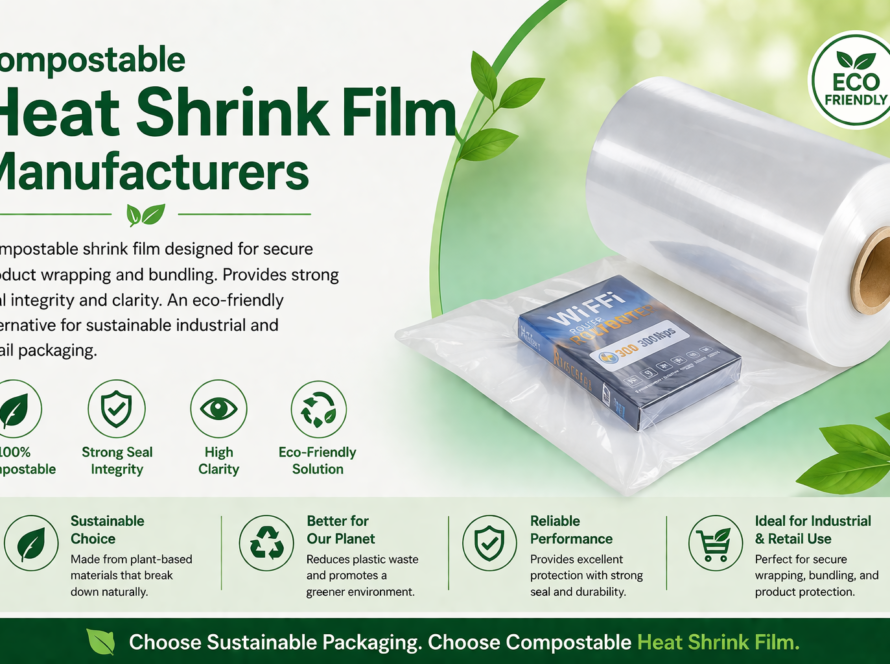
Recent breakthroughs in polymer science have given rise to high-performance compostable films that match the clarity, puncture resistance, and heat-shrink properties of conventional plastics while being entirely plant-based and biodegradable.
These innovative films utilize specially formulated biopolymer blends that react predictably to thermal sealing and shrinking tunnels. Once applied, they hold pallet loads and bundled goods securely during transit, ensuring absolute structural integrity from warehouse floor to retail shelf.
Key Benefits of Transitioning to Sustainable Packaging Solutions
Switching from conventional shrink film to certified compostable packaging yields substantial operational and environmental advantages:
• Perfect Load Stability: Advanced biopolymer films offer high tensile strength and elasticity, securing pallet loads against shifting during long-haul transit.
• Zero Toxic Residue: Unlike conventional plastics that linger for centuries or release harmful chlorine compounds when incinerated, compostable films break down harmlessly into organic matter.
• Alignment with Circular Economy Principles: Businesses can close the loop on packaging waste, converting used wrapping materials into nutrient-rich compost via industrial composting facilities.
• Enhanced Brand Reputation: Corporate sustainability commitments are clearly visible to B2B partners and retail consumers when sustainable outer packaging is deployed.
| Market Insight: B2B clients increasingly require suppliers to demonstrate verified eco-friendly packaging practices as part of vendor compliance audits. |
Engineering Considerations for Packaging Line Integration
Transitioning from petroleum shrink film to compostable alternatives does not require a complete overhaul of existing machinery, but it does demand careful calibration. Temperature settings on heat tunnels and sealing bars often need adjustment, as biopolymers can have different thermal activation thresholds compared to LDPE.
Collaborating with experienced material suppliers ensures that businesses select the precise film thickness and resin grade suited for their specific packaging equipment and weight requirements.
Pioneering Sustainable Protection with Proviva Organics Pvt Ltd
Modern product protection no longer requires sacrificing ecological health for physical security. By replacing conventional shrink films and stretch wraps with advanced compostable alternatives, enterprises can future-proof their supply chains against rising regulations and shifting consumer expectations.
Organizations looking to upgrade their packaging lines can rely on industry leaders such as Proviva Organics Pvt Ltd, which provides cutting-edge, certified compostable films designed for robust industrial performance. Partner with Proviva Organics Pvt Ltd to secure your products while protecting the planet for generations to come.