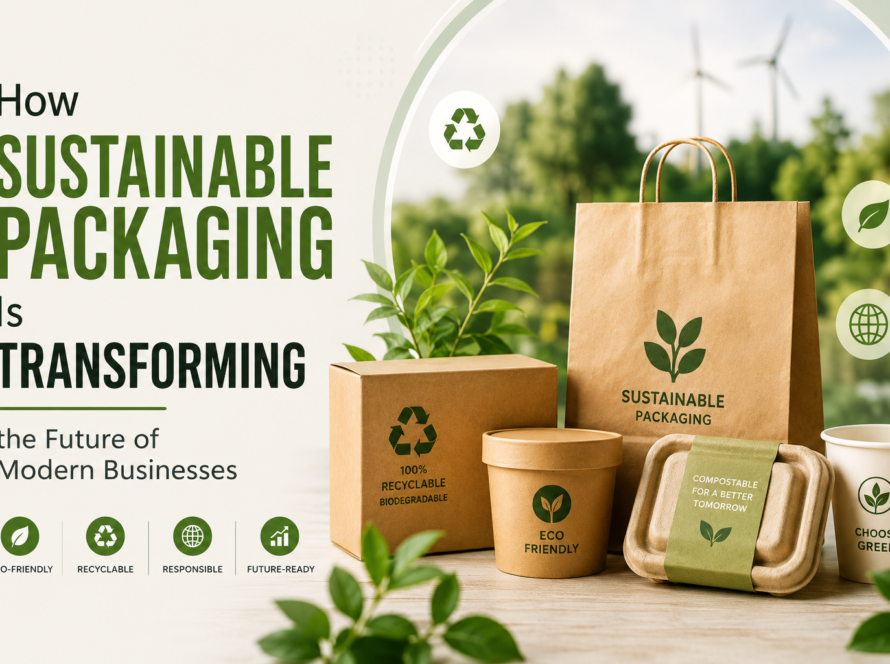
Packaging rarely gets credit for the role it plays in a brand’s reputation. A customer may forget a product description, but they remember the bag it arrived in, the film that wrapped it, and what they did with that material afterwards. For years the default answer was conventional plastic: cheap, light and strong, yet slow to leave the environment once its job was done. Today that default is being questioned by buyers, regulators and investors alike, and compostable packaging has moved from a niche experiment to a serious business strategy.
Why Businesses Are Rethinking Packaging
Three pressures are pushing companies in the same direction. The first is customer expectation. Shoppers increasingly read labels, compare brands and favour those that show a credible effort to reduce waste. Packaging is the most visible proof of that effort, because it lands in the customer’s hands and then in their bin.
The second pressure is regulation. India has tightened its rules on single-use plastics, and authorities expect certified alternatives to meet recognised standards instead of loose claims.
The third pressure comes from the supply chain. Large retailers and export buyers now ask suppliers about material sourcing and end-of-life handling. A company that can show certified compostable packaging has a clear advantage when answering those questionnaires.
What Makes Packaging Truly Compostable
Compostable does not simply mean plant-based or eco-looking. A compostable product is designed to break down in a composting environment into water, carbon dioxide, biomass and inorganic compounds, without leaving toxic residue behind. In India, the Central Pollution Control Board expects such products to be certified against ISO 17088, a standard that tests disintegration, aerobic biodegradation, compost quality and heavy metal content.
Raw materials vary. Manufacturers draw on inputs such as starch, cellulose and lactic acid, often blended with compostable polymers so that the film has the strength customers expect. The result can look and feel remarkably close to ordinary plastic, which is exactly why certification matters. Without a certificate and clear manufacturer marking, a buyer has no reliable way to tell a genuine compostable bag from an ordinary one wearing a green label.
How Compostable Packaging Benefits a Business
The advantages go well beyond a nicer story for the marketing team.
- Stronger brand trust: Certified packaging backs up sustainability claims and gives customers something concrete to appreciate.
- Regulatory readiness: Verified materials reduce the risk of non-compliance as plastic rules continue to evolve.
- Better waste handling: Compostable items can travel with organic waste, which suits food service, grocery and fresh produce businesses in particular.
- Market differentiation: In crowded categories, packaging is a quiet but effective way to stand apart from competitors.
Leaders who want a broader view of this shift can read how sustainable packaging is transforming the future of modern businesses, which explores the same movement from a wider operational angle.
Challenges Worth Planning For
Honest planning matters, because compostable packaging is not a drop-in solution for every use case. Cost per unit can be higher than commodity plastic, although the gap narrows once businesses count avoided compliance risk, brand value and efficient, right-sized designs. Storage also needs attention. Compostable film generally performs best when kept cool, dry and away from prolonged heat, so stock rotation should be planned rather than left to chance.
Disposal infrastructure is the other consideration. Composting facilities are still growing across Indian cities, so businesses should educate customers on correct disposal and, wherever possible, partner with local composting or waste-collection programmes.
Practical Steps to Make the Switch
- Audit current packaging: List every bag, film and pouch you use, along with volumes and purpose.
- Start with visible items: Carry bags, courier bags and produce bags are easy first wins.
- Ask for proof: Request ISO 17088 and CPCB documentation, then trial the material on your own production line.
- Pilot before scaling: Test with one product line or location, gather feedback, and expand gradually.
- Communicate clearly: Tell customers what the packaging is made of and how to dispose of it.
Working with an experienced manufacturer simplifies every one of these steps. Proviva Organics Pvt Ltd produces certified compostable products from plant-based biopolymers, including shrink film, liner bags, courier bags and grocery bags, so businesses can match the material to the application instead of compromising on performance.
The Road Ahead
Compostable packaging is changing business not through one dramatic leap but by raising the baseline of what customers and partners consider normal. Companies that adopt certified materials now position themselves ahead of regulation and ahead of competitors. With a dependable partner such as Proviva Organics Pvt Ltd, the transition becomes a structured upgrade rather than a risky experiment, and the packaging that once ended up as waste becomes part of a more responsible business story.